Showing posts with label Creative Exercises. Show all posts

Sunday, July 14, 2013

Summer Creativity Challenge No.2: (The Necessity of ) Taking on an Unnecessary Project


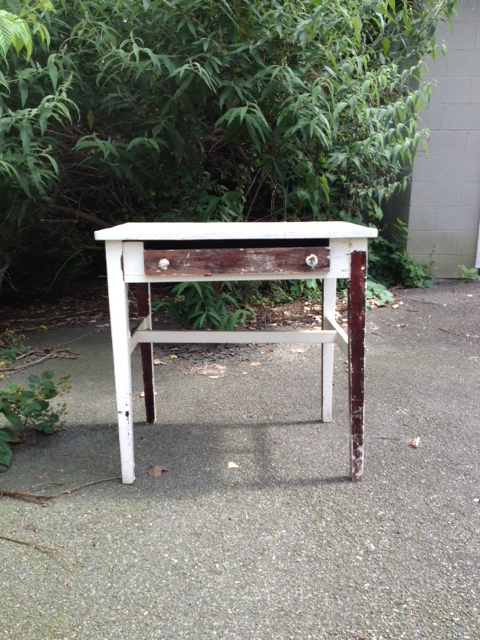
The desk was a gift.  Found in a basement boiler room of a building scheduled to be demolished, it was cleverly disguised beneath multiple layers of paint applied with a heavy hand.  The original silhouette had been altered by the addition of a haphazard plywood shelf, which it wore like a fake mustache.  It was battle-scarred and appeared to have lived a life of many purposes beyond the school room for which it was originally intended.

Opening the drawer on the front revealed a warm stained wood interior with an inkwell, still holding the ancient residue of black ink.  Its potential hidden history and true purpose discovered, it came home with my fiancĂ© where it was deemed to be an excellent find and a great restoration project—for when there was time.

Months passed.  The desk was stored in the basement and once again became a base on which many other things were stacked.  In moments of purging, and feeling “realistic” about the time needed to restore it, it was placed on the curb—only to be brought in again.  There was something about the desk, something about the neat lettering on the inkwell that read in three curved lines radiating out from the nib dipping area, “American Seating Co., Boston No. 59, Pat Apd For,” that wouldn’t let me relinquish it.


Then, one evening a few weeks ago, I was reviewing and integrating some content from author Todd Henry’s book The Accidental Creative into my Creative Thinking class lecture “Where Do Ideas Come From?” designed to inspire students to think differently about where they do their best thinking.   Despite having read the book and put into practice many elements of Todd’s wisdom, I realized that I was missing—and longing for—one key element, which he calls “Unnecessary Creating.”

Unnecessary Creating is actually incredibly necessary for busy creatives.  It is a way to empty or disarm the ever watchful Censor, which I wrote about in last week's challenge.  In keeping busy, the subconscious is left alone to do the magic that it does best: incubate.

My own neglect of (resistance) to Unnecessary Creating, is the same as Todd Henry addresses in his book (p.175):
At this point some of us may be thinking, “I barely have the time and energy to do what’s required of me for my job, and now you want me to take up a hobby?”  It’s tempting to resist this technique because we think it will add stress to our lives—yet another thing that we have to cram into our schedule.  But the experience of those who incorporate this practice is quite different.  They find that it actually clarifies their thoughts, makes them more efficient, and reintroduces a level of passion for their on-demand creating.  In addition, our Unnecessary Creating is often the best source of new insights for our on-demand creative work.”    
Deciding, during the actual delivery of the lecture, that nothing is more beneficial than practicing what I preach, the desk soon came out of the basement and into the hot sun of the driveway.  With a hammer, I knocked off the plywood shelf with a few satisfying whacks.  I was educated on paint removal by my fiancĂ© and soon armed with what he called “a glorified hairdryer” and a spackling knife.  


Soon the paint on the desk was bubbling up to reveal a history of ecru, mint green and yellow lifetimes.  Beneath that, the stained wood still had a start of the school year glow to it.  A hot, sweaty, melting-paint-chips hour later, my “project” began to look more like the desk I knew it could be (although there was still far to go.)  I, too, had a new outlook—won over to the knowledge that Unnecessary Creating is very necessary in my life.

With space to spread out and windows to open, summertime invites hands-on projects.  It is also a great chance to experiment with introducing Unnecessary Creating to your weekly routine.  In Summer Creativity Challenge No.3, this week take a look in your basement, attic, yard, or house and see if you have any projects waiting for you.  Ideally, it should be something that you can sink your teeth into and work on consistently for a few weeks.  Whether is it painting a room, building a bookcase or breaking ground and planting a new garden, get started and see what happens.  Note how you feel and what other endeavors may suddenly feel more-doable.  As always, record your experiences in your sketchbook/notebook and also share here (pictures of your project welcome) on The Paper Compass.   
    

Sunday, November 25, 2012

Creativity Tool Kit #3: Keeping a Gratitude Journal (and Taking Small Steps to Recover Your Creativity)


This post is the third in a series on what I call the Creativity Tool Kit and focuses on a non-traditional creativity tool, the habit of keeping a gratitude journal.  The tools in the Creativity Tool Kit themselves are a series of essentially low-key activities that have a big impact on creativity.  Their purpose is to both cultivate a habit of nurturing creativity and to bring our attention to the present with a sense of curiosity. Individually, they can spark strong ideas, but used in sync they become a natural spring for creative thinking.  I have listed ideas for applying or practicing with the tool at the end of the post.

Creativity keeps you honest.  With the ability to have a handy supply of ideas and solutions at the ready, creativity makes it possible to solve challenges and keep moving forward; your goals glowing and glittering on the horizon growing closer and closer.  So it was difficult to ignore the fact that when my over-booked fall schedule reached a sudden lull and I came back into myself, I realized I couldn’t blame my several-week-long avoidance of the Creativity Tool Kit exercises on my busyness.  My symptoms were classic: huge inertia regarding doing Morning Pages; avoidance of yoga; jittery energy; irritability; an overwhelming desire to sit like a blob; a mind that felt like mush; and an uncontrollable stream of tears running down my face when I watched contestants on shows like The Voice reach for their dreams.  Having been there before, I knew that I was on the fast track to Burn Out.  Worst of all, when I looked towards my career dreams and goals it was like the lights had gone out.  I felt like I had gotten turned around in the desert and was looking at acres of dunes in the moonlight with no clear sense of direction. 

I needed a toe hold to get back on track, but I felt resistant to everything that I usually loved doing that made my brain feel fresh and clear.  When I would go for a walk my mind would tell me I was taking too much time; going to the gym was like wading through molasses; forget even contemplating an artist date, there was no energy for them; and Morning Pages/free writing was either lack luster or sporadic and angry.  I mentally berated myself, a creature of habit and consistency, for being weak willed and having lost my discipline.  It felt like an endless circle and it was not long before the usually very healthy me got miserably sick.  Realizing that I needed to be gentle with myself, I did some negotiating with my battered, grumpy and unhappy self and we decided that the one thing we could use more of is thinking about are all the moments in the day that bring us joy, and the people and circumstances associated with them. 

The human brain (and our ego) loves to fight injustice, be right and be righteous—which is why we tend to dwell on negatives.  They are not always easy to understand, or we feel we can find a way to correct them.  It is well known in customer service-oriented brands that a happy customer will tell three other people about a positive sales experience.  On the other hand, an unhappy customer with a poor customer service story to share will tell nine or more people.  Forget for a moment about what that means for retailers; contemplate how much time it takes to tell and retell that story to nine-plus people!  And consider the emotions it brings up, that you hope to have validated, every time you recount it.  We do the same thing with our day and the negative experiences we are feeling.      

So I agreed with myself that I would go back to basics and be consistent about keeping a gratitude journal.  I would write in it before bed and I would focus on the positive moments in my day.  There would be no “buts” only happy memories, meaning that I could write “I really enjoyed the extra cheese and pepperoni pizza and glass of red wine for dinner tonight” and was not allowed to write “but I really should not have eaten that.”  Only the things that made me happy could be written down and as I documented those moments, they blossomed into the reason those things made me happy.  So while I may have enjoyed the pizza, it was really the fact that my boyfriend and I had uninterrupted time in our schedules together to share a pizza, lounge on the couch and watch one of our favorite TV shows. 

Writing about happy things made the gratitude journal slightly addictive.  I kept it on the nightstand with one of my favorite pens.  Even when I would crawl into bed in the wee hours of the next day, I would reach for it and write.  I also found myself during the day mentally noting the moments that I wanted to remember to write down. 

The gratitude journal, although significant in its own right, was really a vehicle to building my confidence back up that I could be devout and consistent again with my creativity routine.  I just needed small steps that would allow me to emotionally prepare to return to Creativity Tool Kit activities, such as Morning Pages, and address some of the larger issues I was experiencing such as feeling like I was no longer making progress towards my goals, no longer learning and being challenged on a daily basis, and that I was in need of some big (and scary) change. 

While not a classic Creativity Tool Kit item, a gratitude journal is cited as a key element to living an authentic life in books such as Simple Abundance by Sarah Ban Breathnach and was enthusiastically adopted by Oprah a few years ago.  For a long time, my personal attitude towards gratitude journals was similar to that of author Gretchen Rubin in her book The Happiness Project.  Rubin tried keeping a gratitude journal as part of her year-long experiment in happier living.  At a point of reassessment mid-year, she deemed she was fine without the gratitude journal.  While I was familiar with the practice of keeping a gratitude journal, my challenge was that I couldn’t get it to stick.  This make sense when I consider that when all of the other items in the Creativity Tool Kit are in full-swing it is very easy to feel happy, clear minded and able to keep a balanced perspective on both the good and challenging things that happen in a day (or life).  When that is the case a gratitude journal can feel redundant.  Creativity also gives us momentum towards our goals, which gives us the feeling of, while maybe not being “in control” the feeling that we know how to sail our boat on the many surfaces of the sea.

Yet, I was really happy to have this particular “tool” in my Creativity Tool Kit, because when the going got rough, it was exactly the item I needed to ground my thoughts and start re-orienting myself.  It has been 67 days since I returned to keeping a gratitude journal and there have been some major positive changes in my life—and my mood.  I can attest that not many of the decisions for change have been easy ones, but the gratitude journal provided a way back to knowing myself and the creativity tools that have given me the courage to take the steps towards the horizon where I can see my goals glittering once again.            


If keeping a gratitude journal sounds like something you’d like to explore, here are a few tips to get started:
·         For a gratitude journal, I recommend selecting a small notebook or blank journal that delights you.  It should not feel intimidating and should invite casual, happy thoughts.  For my gratitude journal, I indulge in books with textured covers, colorful stitching, even some sparkle—everything my traditional “for posterity” journal is not.
·         Keep your gratitude journal, along with a pen that you like, next to your bed. 
·         Set a time, such as before bed, that you can review your day and list your thoughts.
·         Don’t worry about structure.  Some days you may want to write paragraphs and other days you may scratch out a bullet list.  Write in the way that comes at that moment. 
·         Don’t make it too precious.  Just like all the tools in the Creativity Tool Kit, a gratitude journal is a vehicle to open up your thinking and enhance your awareness.  The goal is to be consistent, not perfect.
·         While it is a “gratitude” journal, don’t hesitate to explore that space between happiness and thankfulness.  Knowing moments where you felt joyful or wise or able to overcome obstacles are all open to inclusion.
·         As my gratitude journal is next to my bed, I also keep space in it for meditations, interesting thoughts, goals, dream images, and general musings.  Overall, though I try and keep the items I jot down in it short, sweet and upbeat.

Having just expressed our appreciation during the Thanksgiving holiday, it is a great time to experiment with keeping a gratitude journal.  I would enjoy hearing your thoughts and experiences especially if you have kept a gratitude journal, keep one, or are just starting.  Share your thoughts here on The Paper Compass.

For other posts on The Creativity Tool Kit see:


Sunday, July 8, 2012

Summer Creativity Challenge #1: The Library


The third floor of the Newton Public Library is a mausoleum for magazines.    

I made this discovery a few weeks ago on a hot and muggy Saturday, on a trifold errand to renew a book, escape the heat, and find an inspired place to do some end-of-the-semester class prep.  Despite the sign on the door that stated that the air conditioning was not working correctly, I marched on and up the spiral steps of the library to the unexplored reaches of the third floor, eager to find a quiet corner to seclude myself in.

Taking a right at the top of the stairs, I discovered a row of unoccupied study desks (thanks to the broken AC) and row upon row of archived magazines in sagging, canvas-covered catalogue boxes or uniform rows of beastly-sized annual editions. 

It was there that I made one of my greatest finds of the summer: an army-green, big-boned volume of House & Garden from 1923.  It sat alone on a shelf, its nearest neighbors a set of volumes beginning in 1963.  Unable to resist, I tugged the mammoth book from the shelf, carrying it through aisles that spoke of different eras (and that I would return to explore in further weeks).  Here was an entire collection of The Saturday Evening Post starting with volumes from 1935.  I passed St. Nicolas Magazine, two shelves of leather bound journals from 1904 to 1912 filled with Edwardian children's stories.  A volume of Harper’s Magazine from 1865, with marbleized cover and gold stamped leather binding.  Which, when browsed, featured current events such as Sherman’s march from Savannah; Sheridan’s operations in the Valley of Shenandoah, “and his junction with Grant’s army, and of the series of actions before Richmond . . . ”  All this news in a size six font on a packed two-column page.  A single paragraph among hundreds of stories of about war and love, many likely read out loud by candle light in the final months of what we would call the Civil War.

The House & Garden volume though was my true obsession.  All other tasks forgotten, I lost myself in the now almost foreign world of 1923.  Articles entitled, “The Electrically Equipped House: In Which Comfort, Convenience, and Pleasure Can Be Increased In Many Ways by the Thoughtful Use of Electric Current,” educated on how many outlets should be in a room.  Advertisements featured maids in crisp black uniforms with knee-length skirts and ruffled white aprons.  There were also ads for automobiles—most from the chauffeured passenger’s point of view.  For “those planning on traveling to Europe and The Orient” there were multiple ads boosting of the being the best cruise ships.  All you needed to do was send a written inquiry and they would mail you a brochure in return. 
"The day of the big, bulky enclosed motor car has gone."
Jordan Motor Car Company
Each individual House & Garden magazine was a fascinating world of black and white photographs of patterned parlors and proper dining room interiors (no intimate spaces like bedrooms and no work spaces like kitchens).  1923 is a prosperous place where the world is full of new “conveniences” and where, in a decorating magazine, the word modern still only means “most current.”  At the time, the Bauhaus School, founded by Walther Gropius in Germany, was only five years old.  The idea of stores such as IKEA, unfathomable. 
"Standard" kitchen sinks, "yard stick high," provide
comfort and prevent back-strain.  How high is yours?
Standard Plumbing Fixtures
What I love the most is that all these magazines and volumes are available to anyone curious enough to look, to get a little dust on their hands.  It is wonderfully straight from the shelves.  No special cotton document gloves, no appointment-only archive room.  It is a perfect exhibit of happenstance, which is part of the magic that is the library.

I am a fan of technology (I have a much-used Kindle) but I will argue that the library is a sacred place.  Not just for readers, but for creative thinkers.  The library offers us the one thing that instant downloads to your e-reader, Amazon reviews, Google searches and StumbleUpon can’t: the tactile act of random discovery.  In the meditative quiet of the library there is no algorithm guiding your search, no SEO, no commercial interest, it is just you and whatever sparks your curiosity.  Who knows why we pick up a book?  It could be the condition of the cover, the typeface of the words in the title, or it could be the fateful mystery of it being out of place on the shelf.  The public library has always been about discovery, education and curiousity, and I would argue that it represents all of those things now, even more than before the "digital age."

All of this is inspiration for the first Summer Creativity Challenge: The Library.  This week, plan an artist date (or at least a half hour) to browse the shelves at your local library.  If you are a student and spend lots of time in the school library, choose a city library, to visit.  Or, if you are a frequent library attending bibliophile, plan time to explore a new-to-you section of the library.  (I still remember my first time discovering the rare book room at the Boston Public Library—it was a holy experience.)  Make sure to bring your library card, or the documents to get one, and a tote bag in the case that you find more than one book you want to check out.  If you are a dedicated eBook Reader, maybe consider switching it up and borrowing your next book from the library.  After all, it is free!
      
With this as your touchpoint, record your impressions, book lists, or library explorations in your sketchbook or notebook.  If the library sparks memories from another time in your life, feel free to capture your memories in detail.  You can interpret this challenge in many ways, as an artist date, writing exercise, or inspiration to start a book list, just to name a few.  Record in your sketchbook any inspiration, ideas, illustrations, or thoughts—then share here on The Paper Compass.