Showing posts with label Summer Creativity Challenges. Show all posts

Sunday, August 25, 2013

Thinking of You


The problem—or maybe the essence—of loving something is that it is always on your mind.  This has been one of the busiest summers that I can remember and through all the moments big and small, excellent and stressful, I have been thinking about The Paper Compass. 

I have carried with me ideas for unpublished blog posts like an ever increasing bunch of balloons.  But the time, and maybe more importantly, the routine that I usually have in the second half of the summer is different this year due to some really happy reasons and a different kind of love (the big “I do” kind!).  So rather than these ideas transforming into the promised Summer Creativity Challenge posts, many have drifted away or, if they were strong enough, have gotten “anchored” to my sketchbook and will be return to for future writing and posts. 

Letting an idea or project “be tabled” is not easy!  I look at my neglected writing (both blog and otherwise), my barely crossed off Summer Adventure list, my towering reading list and I have to remind myself that these are not the signs of someone who is “behind on her work” but rather the signs of a life being well lived.  This is an extra-ordinary year and I recognize that this is its own adventure.

That said, I have decided to lay to rest this summer’s Creativity Challenges and resume them again next year.  Time permitting, I will focus on some other posts in the next few months.

With things on the blog being a little more quiet than usual this year, I want to say thank you so much for being a reader of The Paper Compass.  I am so glad to be able to take the time to focus on something that is a very special moment in my life and bring all my creativity to that endeavor--and the beginning of the fall semester of Creative Thinking--in the next few weeks.

Is a personal creative endeavor taking a back seat? There are a few tools that you can use in the meantime:
•   Create an idea bank: An idea bank is a journal, jar or location where you write down ideas that you can’t begin work on immediately or that you want to explore later.  The advantage of an idea bank is that you always have a selection of ideas to choose from when you complete on project and are not sure about what to do next.  An idea bank is like having a whole batch of ready-bake cookies in your refrigerator!  The best part is an idea from the idea bank can sometimes be a better fit—or “come of age”—at a later time or applied to different circumstances than when first thought up.  I mark my ideas in my pocket journal with a little light bulb in the corner of the page, this reminds me to pull them into my master list when I have a moment.
•   Do a little every day:  If you are working on a bigger project, such as a novel, try and write even one paragraph a day.  If the project truly needs to be temporarily tabled, then make sure to write down any of the character or plot ideas that come to you during the hiatus.  Sometimes a little distance from a story can be where the brain does its best thinking.
•   Think big(ger): A little time away can be a great chance to check in on a long term project.  Where did you start from? Where do you want to go with it?  Is the project going the way that you imagined?  Does it feel like fun or work?  If it feels like work, what can you do to make it feel fun again?
As always, thoughts and comments are welcome—as well as any insight on what you do when you have to juggle priorities and creative endeavors. 
I'm not complaining a "wish you were here" postcard circa 1915

Sunday, July 14, 2013

Summer Creativity Challenge No.2: (The Necessity of ) Taking on an Unnecessary Project


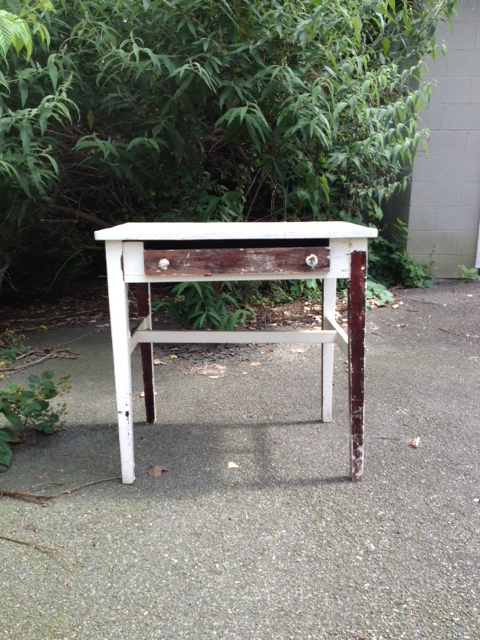
The desk was a gift.  Found in a basement boiler room of a building scheduled to be demolished, it was cleverly disguised beneath multiple layers of paint applied with a heavy hand.  The original silhouette had been altered by the addition of a haphazard plywood shelf, which it wore like a fake mustache.  It was battle-scarred and appeared to have lived a life of many purposes beyond the school room for which it was originally intended.

Opening the drawer on the front revealed a warm stained wood interior with an inkwell, still holding the ancient residue of black ink.  Its potential hidden history and true purpose discovered, it came home with my fiancé where it was deemed to be an excellent find and a great restoration project—for when there was time.

Months passed.  The desk was stored in the basement and once again became a base on which many other things were stacked.  In moments of purging, and feeling “realistic” about the time needed to restore it, it was placed on the curb—only to be brought in again.  There was something about the desk, something about the neat lettering on the inkwell that read in three curved lines radiating out from the nib dipping area, “American Seating Co., Boston No. 59, Pat Apd For,” that wouldn’t let me relinquish it.


Then, one evening a few weeks ago, I was reviewing and integrating some content from author Todd Henry’s book The Accidental Creative into my Creative Thinking class lecture “Where Do Ideas Come From?” designed to inspire students to think differently about where they do their best thinking.   Despite having read the book and put into practice many elements of Todd’s wisdom, I realized that I was missing—and longing for—one key element, which he calls “Unnecessary Creating.”

Unnecessary Creating is actually incredibly necessary for busy creatives.  It is a way to empty or disarm the ever watchful Censor, which I wrote about in last week's challenge.  In keeping busy, the subconscious is left alone to do the magic that it does best: incubate.

My own neglect of (resistance) to Unnecessary Creating, is the same as Todd Henry addresses in his book (p.175):
At this point some of us may be thinking, “I barely have the time and energy to do what’s required of me for my job, and now you want me to take up a hobby?”  It’s tempting to resist this technique because we think it will add stress to our lives—yet another thing that we have to cram into our schedule.  But the experience of those who incorporate this practice is quite different.  They find that it actually clarifies their thoughts, makes them more efficient, and reintroduces a level of passion for their on-demand creating.  In addition, our Unnecessary Creating is often the best source of new insights for our on-demand creative work.”    
Deciding, during the actual delivery of the lecture, that nothing is more beneficial than practicing what I preach, the desk soon came out of the basement and into the hot sun of the driveway.  With a hammer, I knocked off the plywood shelf with a few satisfying whacks.  I was educated on paint removal by my fiancé and soon armed with what he called “a glorified hairdryer” and a spackling knife.  


Soon the paint on the desk was bubbling up to reveal a history of ecru, mint green and yellow lifetimes.  Beneath that, the stained wood still had a start of the school year glow to it.  A hot, sweaty, melting-paint-chips hour later, my “project” began to look more like the desk I knew it could be (although there was still far to go.)  I, too, had a new outlook—won over to the knowledge that Unnecessary Creating is very necessary in my life.

With space to spread out and windows to open, summertime invites hands-on projects.  It is also a great chance to experiment with introducing Unnecessary Creating to your weekly routine.  In Summer Creativity Challenge No.3, this week take a look in your basement, attic, yard, or house and see if you have any projects waiting for you.  Ideally, it should be something that you can sink your teeth into and work on consistently for a few weeks.  Whether is it painting a room, building a bookcase or breaking ground and planting a new garden, get started and see what happens.  Note how you feel and what other endeavors may suddenly feel more-doable.  As always, record your experiences in your sketchbook/notebook and also share here (pictures of your project welcome) on The Paper Compass.   
    

Sunday, July 7, 2013

Summer Creativity Challenge No.1: (The Pursuit of) Two Kinds of Happiness

"Ground Swell" Edward Hopper, oil on canvas, 1939

Summertime engages our senses.  The world is vibrant with color: the green of grass, the rainbow of fruits and vegetables at a farm stand, the blue of the ocean meeting the sky at the horizon.  The days are filled with the scent of humidity, tomatoes on the vine, the scent of ozone before a flash of lighting.  Birds sing, waves break, the beat of radios and murmur of neighbors talking on the porch comes in the open windows.  We wear less clothing to allow our skin to soak up the sun.  We open ourselves to summer.

This symphony of the senses makes summertime the ideal time to restock the source of our creative juices.  In this season of long light and slow heat, it is a perfect time to play, to explore and to inspire your creativity.

This is the fourth summer of weekly Creativity Challenges on The Paper Compass.  For the next six weeks this summer, there will again be a theme to meditate on, a small task to fulfill, or a memory to be explored.  Some challenges will take you to new places, others to past experiences, and all hopefully to a wealth of ideas to compile in your sketchbook or notebook.  Consider it your season of creative harvest, abundant with ideas to delight your mind or spark an even greater artistic endeavor. 

This summer we begin, inspired by one of the core values celebrated on Independence Day: The Pursuit of Happiness.  Creativity and happiness are an interesting pair.  As Po Bronson and Ashley Merryman write in the Newsweek article, The Creativity Crisis, “… [C]reative people, for the most part, exhibit active moods and positive affect. They’re not particularly happy—contentment is a kind of complacency creative people rarely have. But they’re engaged, motivated, and open to the world.” 

Creatives, as agents of change, big and small, are driven.  With this drive comes what author Julia Cameron in her book The Artist’s Way calls The Critic.  This negative (and untrue) voice can be a huge hurdle for creatives pursuing their happiness.  The Critic is loud and eagerly points a finger at anything less than perfect, often keeping ideas from even arriving at their first destination: the blank page or the blank canvas. 

But summertime, by any definition of perfection, is far from perfect.  Summer is wild.  It is extremes.  It is a profusion of heat, bugs, sun, vegetation, and sand.  It is the boisterous person at the party who sets off fireworks, turns up the radio, and pushes people in the pool.  And this makes it the perfect time to give yourself some space away from The Critic in order to explore more of your creative happiness.

The interesting thing about happiness is that it is both a present state and a memory.  Our “experiencing selves” and our “remembering selves” perceive happiness differently as documented by Nobel Laureate and founder of behavioral economics, Daniel Kahneman.  We don’t always experience happiness in the moment, but we often look back on an experience and our brain has categorized it as “happy.”  If something ends on a happy note, we often remember the whole experience through rose colored glasses—even if we were bored silly, disgruntled or exhausted for the majority of the time.  A five day vacation where it rained for four days and ended on one sunny day?  Excellent!  The 90 minute wait in an endlessly snaking line for a joyous ten minute ride at Disney World?  Forgotten!    

While science has proven the two kinds of happiness true, I need only to look to my own experience of being at the gym to see it in action.  I have many happy memories of time spent on the elliptical watching the Food Network (oh, the irony!) or traveling to exotic locations vicariously through the Discovery Channel.  Yet, when I am actually at the gym, in the heat of physical exertion, I promise you that happiness is the last emotion on my mind. 

Exploring the two kinds of happiness in this summer creativity challenge allows us to identify things that make us happy in the moment (like petting a cat or reading on the back porch) and most importantly for creativity, the things that make us feel happy in retrospect (like having written this blog post).  Both are important as one grounds us in time and the other helps us “do the work”; the work that makes our creativity and ideas a reality.  The promise of happiness in the future is a huge motivator, but most importantly it is important to explore our pursuit of happiness.  Being in pursuit of something means you are on a journey.  If you watch carefully and observe the process of working on a creative endeavor, you may suddenly see more moments of happiness than you believed existed.  And suddenly that blank page looks a lot more inviting.   
      
This week, for Summer Creativity Challenge No.1, spend some time contemplating your own pursuit of happiness.  Make a list of things that make you happy in the moment.  Or observe very carefully the things that bring you happiness.  Also, make a list of the things that you remember as being happy.  Revisit them.  What made you remember it as being a happy experience?  Often you will discover themes rather than things or places or people are at the heart of happiness.  What themes (such as travel, exploring, being outdoors, having long, intimate conversations) do you see in your memories of happiness?  Are any a source for an Artist Date or Adventure?  As always, document your thoughts in your sketchbook/notebook and share any thoughts or questions here on The Paper Compass.
     

Sunday, June 2, 2013

Devouring the Pie: Creativity, Routine, and a Meditation on Time

For creatives, who so often see solutions to the many challenges or opportunities presented to them, saying “yes” comes easily.  It takes you in exciting, new directions, allows you to flex new thinking skills, and—more often than not—divides your focus so that your pie is full of many little slices. 
During my freshman year at Boston University, I had a French teacher who, through no fault of his own and like many others before him, was unsuccessful in teaching me to improve my abysmal French.  However, he did make a lasting contribution to my life regarding my comprehension of time.

One day, during a tangent in the middle of a lecture, the professor turned to the board.  His tonsured head reflected the florescent lights as he drew a large circle, sliced it into lines with a piece of chalk and declared: “Time is just one big devouring of pie!”

I have written before of this epiphany. This random statement—capturing the essence of time as a limited resource (while in the middle of conjugating verbs)—has only continued to prove more and more true the older I become. 

Time is like a pie, and however you slice it, there is only so much of it in a day.

For creatives, who so often see solutions to the many challenges or opportunities presented to them, saying “yes” comes easily.  It takes you in exciting, new directions, allows you to flex new thinking skills, and—more often than not—divides your focus so that your pie is full of many little slices.  Or, if you are a focused creative, with much willpower, who is Getting Things Done, then your pie is probably divided into only a few big slices.

This has been one of my meditations as The Paper Compass lay fallow during the snowy Boston winter and tragic, strange days of early spring.  I thought about it frequently as my life had taken off in some surprising, wonderful and new directions, and taken my blogging time—and perhaps even more importantly—my routine, with it.

If time is like a pie, creativity is like water.  Unless directed it follows the path of least resistance.  Sometimes it carries you along, and other times, you are responsible for laying the duct work, building the dams, making sure that it doesn't overflow the banks, or dry up completely. 

While all was quiet on The Paper Compass, creativity was flourishing through different outlets. A proposal—and joyful answer of “yes!”—have brought the whirlwind that is wedding planning to my life.  To mark this happy occasion, I found myself pleasantly engaged again in crafting handmade gifts and keepsakes for my family (images below).  I also flexed my creative writing muscles working on a draft of my novella under the direction of a talented student editor in Emerson College’s Publishing Program. 

A handmade card asking my sister to be my MOH


A MOH Survival Kit complete with instructions


A playful customized gift tag asks my brother if he'll walk me down the aisle
A keepsake box for my mom contains a garland made up of family wedding photos

I kept returning to my meditation on time as pie though, because at the heart of creative process is routine.  While we could speak endlessly about creativity and time as the best of frienemies, it is really your routine that allows you to do the work.  There is limited space for creative endeavors within a day, because time is limited, so it all comes down to choice, priorities and “pruning”, as author Todd Henry of The Accidental Creative calls it.  While I made advances on other creative projects in my life, The Paper Compass was placed on the proverbial back burner. 

The good news is that no creative endeavor is truly endless.  In fact, creativity like all things, has its cycles.  Which is why I am pleased to say, that the heat wave that has ushered in June in the Northeast has also brought back my summer routine: the summer semester of Creative Thinking & Problem Solving is underway and my thoughts once again turn to blogging, writing, and the Summer Creative Challenges.    

The lyrics of John Lennon remind us that, “Life is what happens while you are busy making other plans.”  So while I can’t promise that this will be my most prolific blog year (it is the fourth year of The Paper Compass!), I can say that The Paper Compass is “back” and I will do my best to integrate my creative outlets and post here for sharing, thoughts and inspiration for your own creative journey.


All this talking about pie is perfect for some food for thought (pun intended!) or discussion below:
  • If your day was a pie, how would it be sliced?  What slices are the smallest? What are the largest?  Can you make any changes to prioritize small slices of the pie?
  • How much time is set aside for creative endeavors?  
  • Do you have a creative routine?  If not, what are some of the ways that you could create one?
  • How do you prioritize personal creative endeavors in your schedule?
  • And one question that has been important to me in the past several months is: How do you bring patience to your creative process?


Sunday, August 26, 2012

Summer Creativity Challenge #8: The Ant & the Grasshopper


In the final week of the Summer Creativity Challenges, we use Aesop’s fable The Ant and the Grasshopper to contemplate the dual nature of our own creative habits.  Inside every creative is a Grasshopper, who just wants to play, and an Ant, who plans, worries, and works.  In this interpretive challenge, I invite you to explore the fable of The Ant and the Grasshopper and contemplate what ideas and experiences you will take with you from the summer to the fall to fuel your creative endeavors. 


It is August, but I am already thinking about September.  It comes from small cues: the shortening of the daylight; the dry rustle of leaves in the driveway. 

As I walk home from work, my head filled with future third quarter work deadlines and thoughts of the encroaching fall semester, I find myself thinking about The Ant and the Grasshopper.  In this fable, a live-for-today grasshopper tempts a young ant to put down his work during the summer and play.  The ant is kept in-line by the other members of his colony.  As the seasons change, the grasshopper finds himself exposed to the elements and starving from his lack of preparation, while the ants feast on their harvest beneath the snow. 

There is some inconsistency in my memory.  I can’t remember what became of the grasshopper who liked to play.  Being a fable with its moral lessons, I think, it can’t be good

I have a mind for books, with the ability to retain plot lines and details about characters.  Television and movies are another matter entirely though, especially anything I watched when I was little.  In my head is a jumble of impressions from Donald Duck tormenting Chip and Dale to a man in a full bodysuit illustrated with all his internal organs that I saw one morning after Sesame Street.  These images are random, raw and out-of-context; fragments of things that I think my child-mind was not sure how to process.  My mental images of The Ant and the Grasshopper fall into this category. 

There is something about my incomplete memories of the fable that does not sit well with me.  So I take my images of a starving grasshopper in a tattered coat tightening his belt as he walks through the snow; of leaves blowing away on a cold wind; and ants in little lines rolling fruit into their home in a tree stump to YouTube to do some research.  It is not long before I find a match in A Walt Disney Silly Symphony entitled “The Grasshopper and the Ants” from 1934.  With ants whose facial features foreshadow Mickey Mouse (sans ears), and a grasshopper who sounds like Goofy, I know that this is the odd little version of this fable that has lodged itself in my brain.

Watching the cartoon again brings some resolution.  The ants take the grasshopper in from the cold, and the wise queen ant shows him that his “work” is to play his violin at their feast.  Through the lens of history, I can see the “Disneyfied” (less grim) interpretation of the fable and the influence of The Great Depression in this Silly Symphony.  For me though, it now makes sense as to why this fable comes to mind at this time of year.  My inner grasshopper still wants to play, but my inner ant is getting anxious about deadlines and planning for the busyness of the months to come. 

These two parts feel like they are in conflict these final weeks of summer.  In understanding of the process of creative thinking though, I know they are not.  In creating habits to nurture creativity, such as the exercises in these blog posts, I (and you as a reader) have actually been working very hard this summer. 

In creativity, through play we take risks, incubate ideas, and expose ourselves to new ideas that refill the well.  Like the ant in the fable, we’ve stocked up our thinking supplies, but we did so by letting our inner grasshopper out.  In the coming months, I know that my inner ant will reign supreme (which I am looking forward too) but I hope that just like the Queen Ant in the cartoon, that she will be kind, generous and frequently hand the grasshopper his fiddle and ask him to play.                        

All of this is inspiration for the eighth and final Summer Creativity Challenge: The Ant and the Grasshopper.  This challenge is a great opportunity to check in and take an hour with your sketchbook and note what ideas and experiences you’ve generated this summer.  Make a list of how you can use them in upcoming projects, or identify new projects to take on this fall and winter.  It is also a good challenge in which to meditate about your inner grasshopper and ant.  Do you give them equal “floor time”?  If you become a very serious Ant in the fall and winter now is a good time to set some goals or plan some time to let your Grasshopper out.     

With this as your touchpoint, plan some time to think about The Ant and the Grasshopper and consider what the fable means to you as a creative.  Record impressions, inspirations, ideas, and memories in your sketchbook and share here on The Paper Compass. 
    

Sunday, August 12, 2012

Summer Creativity Challenge #6: The Night Sky

Detail from Vincent van Gogh's Starry Night Over the Rhone

In this week’s creativity challenge we look up to the night sky, a source of inspiration and mystery.  In light of a week filled with the news around the landing on Mars of the appropriately named rover, Curiosity, and the Perseid meteor showers peaking in the morning’s early hours, I thought that this was the perfect week for this challenge.  The night sky gives us the chance to bring our attention to the immense scale of the universe, which then allows us to see the magic in the details of the everyday. The night sky offers us the gift of perspective, an important trait for creativity, as we need to be able to see both the big picture and the fine details when creating our idea, concept or craft.    

My first true taste of the augustness of the night sky took place on a hillside in Vermont during the summer vacations of my childhood.  Usually at some point in the late summer, my parents would pack us all into my dad’s grey Volkswagen Vanagon.  We would head north from Connecticut to The Highland Lodge in Vermont in what felt like an interminable car ride that no amount of car trip BINGO or travel Connect Four could shorten.  Gradually, the landscape changed from highway to narrow roads banked by fields of cows that undulated over rows of steep hills, letting us know that we were finally close to our destination.   

Rising behind the white farm house that was the main building of The Highland Lodge was a ridge dotted with a row of white cabins.  It was on this steep hill, on a plaid wool blankets taken from the ends of the beds that all of the kids at the inn (my newest friends made that week) lay lined up like sticks, the sky our only concern, while the adults peppered the activities with flashlights, snacks and bug spray.  This is how I watched my first meteor shower, the sky rich with dashes of light. 

Years later in Florida, I would read sci-fi books, watch the white-bright-burn of the shuttle launches, and look up to the dark heavens from the driveway.  On some nights, the sky was so populated with stars that I could see beyond the usual constellations all the way to other galaxies such as Andromeda and the Large and Small Magellanic CloudsOther galaxies, I would say to myself, somehow hoping to memorize that fleeting feeling of, for one moment, grasping the scale of the universe. 
   
Now, as it was then, the night sky is still a source of wonder—and also a source of wishing.  Despite the lights of the city illuminating the immediate horizon, I can often look up and see the Big Dipper and Little Dipper, and find my favorite constellation, Orion, by his bright belt.  When I turn my gaze to the sky, I find myself still wishing on stars.  This is because when I look at the night sky it reminds me that there are still many mysteries out there to be explored and charted, and some things to that will always remain unknown, a sentiment—poetic perhaps—which speaks to me as the navigator of my own tiny life in this immense universe.   

All of this is inspiration for the sixth Summer Creativity Challenge: The Night Sky.  This challenge is open to your imagining and interpretation.  You could take the time this week to stand in your driveway each night and look up, or download an app such as The Night Sky and learn the constellations.  Or this could be the effulgent spark of a creative endeavor such as writing a piece of flash fiction where someone wishes on a star.  If you paint, this could be a chance to work inspired by the night sky or moonlight.  You can also remember your own memories of stargazing, or nights under the stars.

With this as your touchpoint, plan an artist date, step outside, write or paint with the inspiration of exploring and remembering your backyard.  Record impressions, inspirations, ideas, and memories in your sketchbook and share here on The Paper Compass. 
    

Sunday, July 15, 2012

Summer Creativity Challenge #2: The Hunt & The Perfect Find


A box of Victorian monogram stencils at Brimfield
Inside the tent it is dim and still.  The canvas walls are hung with shallow shadow boxes in tight and tidy rows.  Inside each is a small storm of objects from arrow heads to lady’s pistols to campaign buttons with hairstyles that date the people in them to my great-great-grandparent’s era.  In a corner there is a tall shelf which is the current home of a handmade Eskimo doll who leans languidly against a bottle of Frigid Fluid Co.’s branded embalming fluid circa 1900.  The bottle is still full.

Across the tent, a man standing behind a table marks him as the booth’s owner.  He looks like he simultaneously stepped off his Harley and stepped away from conferring with J.E.B. Stuart over the Confederate’s next move in order to talk to customers.  He has recognized a previous patron, decked out in a stylish straw hat with a brim which would make the British proud.  He is telling her of his latest finds, the point of his salt-and-pepper beard moving up and down over his solar plexus as he speaks.  He has a voice full of gravel and as flavored with the West as his framed memorabilia.  Concluding business with the wide-brimmed hat, he wishes her the felicitous salutation of the day, “Happy hunting.”

The main street of the town of Brimfield during the show
I am at Brimfield, one of the largest antique shows in the country.  And I am hunting too.  Happily.  So is my boyfriend and our friend Cassy, who has taught us the ropes, being a long-time Brimfield veteran.  Tents filled with everything from fine antiques to collectibles and hidden treasures stretch the length of several (approximately ten) football fields.  Some booths are cluttered with odds and ends--old photos, books, random pieces of china, vintage toys--and as you explore your hands come away dusty.  Others are as pristine as a china shop, with linen covered tables displaying polished silver serving pieces, claw-footed curio cabinets, and full sets of Depression Era glass all vying for new owners while their prices break the hearts of many admirers.  If shopping is now a form of entertainment, then Brimfield is the Comi-Con of antique shows. 
A Brimfield booth filled with industrial items and index card cabinets
Brimfield is a feast for the eyes and a playground for the memory and imagination.  When I browse—stepping from tent to tent, my eyes adjusting from sunlight to shadow; hot, still air to warm, fan-blown breezes, to browse the wares—I enter a state of flow, quickly loosing track of time (and also often of my companions.)  The three of us have what we call in Creative Problem Solving “fuzzy goals” which means that we have an idea (and ideal) of what we are looking for, but are willing to be lead in new directions.  


At Brimfield, we return to an early form of shopping where exploration, perseverance, and even negotiating evoke the thrill of The Hunt.  It is a place where The Perfect Find—a combination of serendipity, memory/imagination, desire, and price—often feels like it finds you. What I like most about Brimfield and the variety of vendors and items is that The Perfect Find is often not a wallet-breaker, but something that speaks to you in that moment.  One of the items that Cassy scored yesterday was a team image of the 1982 Celtics that reminded her of the ones that use to hang on her family’s refrigerator door when she was younger.  It was a steal at $1.

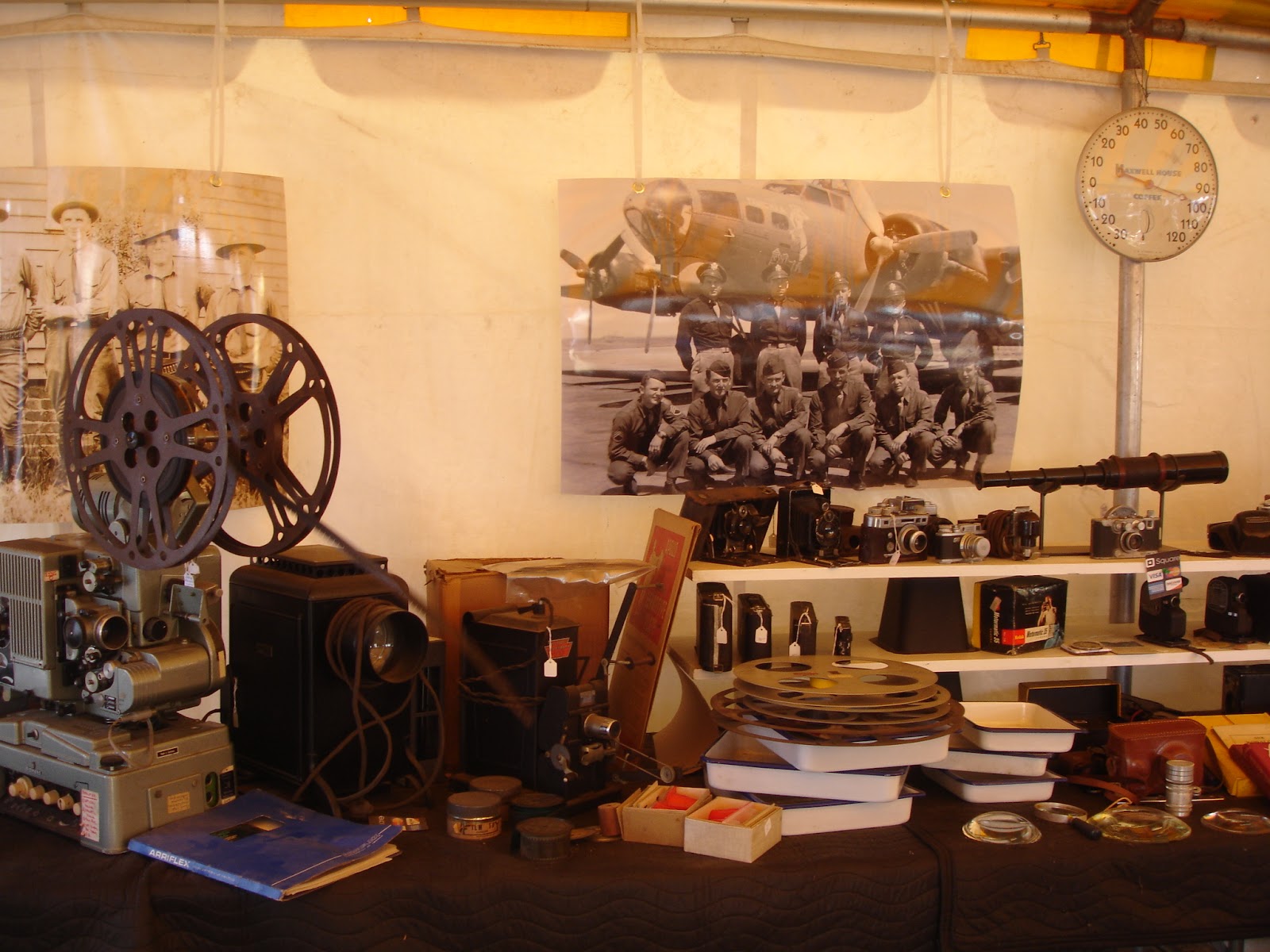
A Brimfield booth specializing in film and photography
More than antiquing, this is a post about the places that we go to “hunt”—to shop, to browse, and to acquire.  We all have them.  For some, it is the local music store where you browse records and CDs.  For others it is the bookstore, where you disappear for hours, cappuccino in hand.  It is also the gift shop, the home décor store, or that sale rack in the back of the department store that you know just when to visit.  

These places are about more than just shopping, they contain several aspects that create the perfect frame of mind for creativity and embody the Creative Problem Solving Process:
·         You go on a whim or because you have a hunch
·         You are excited and open minded in your approach to the task
·         You have a “fuzzy goal” in mind, which leaves you room to explore alternative solutions  
·         You have to observe and try out all the options in the environment
·         You evaluate the items that have stood out
·         You make a decision and take action (purchase or not purchase)                       
We have these stores, shops or events like Brimfield in our lives because we need environments that we can explore in and mingle with others that share our passions.  Most importantly being on The Hunt consciously (or unconsciously) for The Perfect Find is about being open to unexpected solutions and serendipity (and a touch of happenstance, which I wrote about last week).

All of this is inspiration for the second Summer Creativity Challenge: The Hunt & The Perfect Find.  This week, plan an artist date (or at least an hour) to browse one of your favorite stores or shops.  This is a great time to revisit an old favorite shopping haunt or head into a store that is new to you.  Most importantly, there is no pressure or need to purchase anything for this challenge.  Browsing is a great way to enter a state of flow, which is refreshing for the creative process.  If you have something in mind that you do need to make a purchase for, this is a great time to be aware of the Creative Problem Solving steps and explore how being in an environment where you are comfortable exploring options (divergent thinking) makes you feel, verses an environment where you are focused on getting to a single solution (convergent thinking).  In this challenge, take the time to be aware of how the environment engages your senses. If you don’t have a current haunt in which to Hunt for The Perfect Find, you can use this challenge to remember a favorite place or find a new one.
     
With this as your touchpoint for this interpretive challenge, record your impressions, memories, explorations, or even the merchandise that you found most interesting in your sketchbook or notebook.  Please also share your thoughts, experiences and ideas here on The Paper Compass. 
     
Creepy Brimfield Baby Doll

Where else can you find a vintage polygraph machine?

Even the dummies at Brimfield are having a good time

Brimfield railroad glass pieces
All this exploring with the scent of fresh made donuts in the air